What most people know about the Shakers could be summed up in a few words: cool furniture, practiced celibacy.
But there is a world of interesting things about the Shaker people waiting to be explored at the Canterbury Shaker Village.
Yes the Shaker’s were extraordinary craftsmen creating everything from simple and beautiful furniture to basketry and weavings. But they were also inventors, scientists, philosophers, civil libertarians, abolitionists, songwriters and much, much, more. Did you know that the Shakers invented the washing machine? The circular saw? The clothespin? Did you know that they were horticultural pioneers, developing hundreds of new species of plants and herbs through genetic cross breeding? Did you know that they created hundreds of other time saving devices and have even been credited with developing mass production before Henry Ford made it world-famous?
The Shakers are considered to be an offshoot of the Quakers. The sect originated in Manchester, England in around 1772. Strict believers in celibacy, Shakers maintained their numbers through conversion and adoption. Once boasting over six thousand adherents, today the Shakers, with the exception of a small contingent of people living in Sabbathday Lake, Maine, are but a memory.
Originally and properly called the United Society of Believers in Christ’s Second Appearing, the Shakers, like the “Yankee Doodles” of the same era, derived their common name from a pejorative appellation adopted by the group as a source of pride.
Under the leadership of James and Jane Wardley, a husband and wife team; and, most notably, by Mother Ann Lee, the group became known for their intense, ecstatic worship including shaking or quaking during religious activities and at times speaking in “tongues” - both of which were considered signs of divine intervention and inspiration.
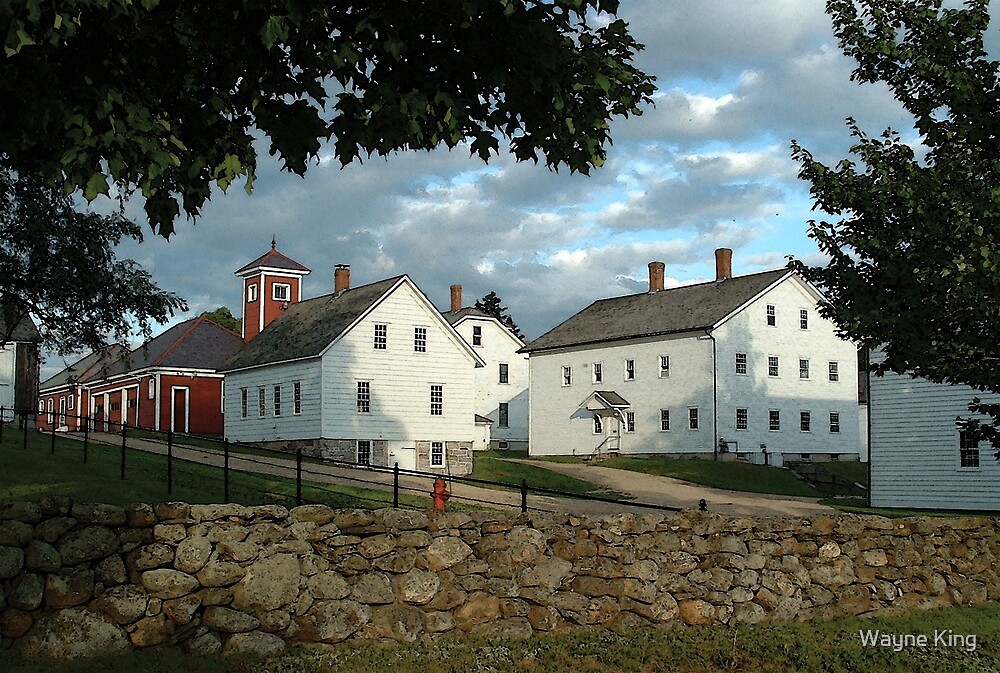
Today in New Hampshire the Shaker life and legacy and heritage remains alive through the work of the Canterbury Shaker Village. Founded in 1969 to preserve the heritage of the Canterbury Shakers, Canterbury Shaker Village is an internationally renowned, non-profit museum and historic site with 25 original Shaker buildings, including the only intact, first-generation 18th-century Meetinghouse and Dwelling House, both on their original sites. There are also three reconstructed Shaker buildings and 694 acres of forests, fields, gardens and mill ponds under permanent conservation easement.
Designated a National Historic Landmark for its architectural beauty, integrity and significance, Canterbury Shaker Village is dedicated to preserving the 200-year legacy of the Canterbury Shakers and to providing a place for learning, reflection and renewal of the human spirit.
Visitors learn about the life, ideals, values and legacy of the Canterbury Shakers through tours, programs, exhibits, research and publications.
In addition to the daily tours, during the course of the year, the Village sponsors many community events that draw local folks and visitor from far and wide. For example the annual “Wool Day Festival” at the Shaker Village takes place this year on September 23. We detail it in the “50 Autumn Adventures” story elsewhere in this issue.
Canterbury Shaker Village is a treat for the heart, soul and palate. If you haven’t yet been, it should be on your list. If you have been, it may be time to recharge your spirit with another visit.
Editors note: All of the tour guides at Shaker Village are first rate, but as my son Zach says, “a tour with Darryl Thompson (son of museum founder Charles "Bud" Thompson ) is a magical and humorous experience.”
Time is like a
river: always passing, never still. So, in a way, stepping into a river can
be
like stepping into time. Now, with this line of thinking, imagine if one could
reverse the course of a river. Would it not equate to the turning back of time?
Humor this author if you will, and let us do just that, and not just with any
river, but with the mighty Saco River of New Hampshire and (grudgingly) Maine. Born
in northeastern New Hampshire, the Saco River is the child of Saco Lake in the
White Mountains’ Crawford Notch. Several major tributaries (including the swift
and cold) Swift and Cold Rivers, contribute to the growth of this wild child as
it runs south-southwest for 134 miles, through the towns of Bartlett and
Conway, New Hampshire. The Saco River then leaves the granite state for York
County, Maine, where it passes between the towns of Saco and Biddeford on its
way to its ultimate destiny, the Atlantic Ocean. See
the river flowing upstream now, several hundred years to another birthplace:
that of legends, for the surging life-force of a river such as the Saco cannot
help but give rise to such things. The following legend is just one of many
stories of Gluscabe, whom New England’s Abenakis considered the creator of all
things.
Gluscabe
and the Mighty Magicians
Gluscabe had
been the friend, when he was young, of a family of powerful magical giants. As
the years passed, rumors abounded that this family of giants was evil, killing
and eating people indiscriminately. Now Gluscabe, who was himself a magician,
set out to find the truth. Disguising himself, he went among the family of giants
found along the Saco River between Mt. Kearsarge and Cathedral Rocks, near
today’s “Dianna’s Bath.” Suspicious of
him, the family tested Gluscabe severely, aiming to destroy him. Yet with each
attempt, Gluscabe overpowered them, until finally, he stamped his feet on the
sandy shore of the Saco River and water came gushing down from the mountains,
carrying the family downstream. Gluscabe sang a magic song and the evil magician/giants
became fish and were washed away to sea. As the legend goes, these bad guys
were wearing wampum collars that “may still be seen today.” In my research,
I discovered that the Collared (sometimes called the Necklaced) Carpet Shark is
indigenous to Atlantic waters. Hmm…
Research on
this next legend turned up various versions of what prompted a New England
Native American chief to put a curse on the Saco River. In one version, his
daughter was kidnapped by white men. In another, he had been friends with the
white men who caused his infant son’s death. In still another, the deed was
done by sailors, who killed both his wife and his son. Perhaps it doesn’t
really matter which version is embraced, as death occurred in every case. Chief Squando
was a family man until the fateful day he lost his family – namely, his wife
and son. It is said that the family lived along the Saco River, near Saco
Island in Maine. The wife of Chief Squando was paddling along the river with
her infant son one day, when several feisty sailors came exploring up the
river. Spying Squando’s wife canoeing with her child, the sailors began to
torment her. Wondering if it was true that Native American children were
natural swimmers from birth, they snatched the baby from his mother’s arms and
tossed him into the river. Needless to
say, the child sank. Diving in after her son, Squando’s wife also perished.
Grief-stricken, Squando turned against the white men that day with a curse.
From then on, he claimed, the Saco River would take the lives of three white
men every year. It is said that
this story did not begin to surface until about 100 years or so after the
supposed incident. Some think it the wild conjecture of a publicity seeker. It
is true, however, that in both New Hampshire and Maine, while on its long,
meandering journey to the sea, the Saco River claims lives every year.
Though not a
legend than a ghost story, this last story is repeated because of its
association with the Saco River and Saco Bay in Maine. One night, in
the early 1890s on Wood Island, where the Saco River empties into Saco Bay, a
drunken young squatter who lived on the island returned from a night of
carousal on the mainland. In his stupor, he was carelessly wielding his rifle.
Confronted by another Wood Island resident, a lobsterman and part-time special
policeman, the drunkard shot and killed him. Afterward, the
young man staggered to the island lighthouse, where the keeper advised him to
turn himself in. Now distraught, the killer went back to his shack on the
western part of the island and did himself in. People insist that the ghost of
the murdered lobsterman is still on the island, and is responsible for many
strange happenings that have occurred there over the years. It is thought by
some that he is looking for the rotter that took his life near the water, not
knowing he’s a goner. He really oughter - be informed, that is.
Ed's note: Provided by Heart of New Hampshire magazine and published here to assure that the work not be lost.
The
sound made by drums is the heartbeat of the Earth.Each bead, feather or design is an offering to the Great
Spirit. The beauty found in utilitarian objects is the pride and the gift of
their makers.If the United States
is a melting pot, then we run the risk of losing its amazing diversity. To take
an alternative point of view, if America is a tapestry that celebrates each
vibrant strand, then Native Americans are the original strands.
Mt.
Kearsarge Indian Museum is a place where you can
connect with the Great Spirit and the cultures of America’s native peoples. The
museum strives to be a center of learning, fun and respect for Native American
cultures. You don’t need a special event for the MKIM to be a great adventure
but if you’re looking for one their Harvest Moon festival in early October - overseen by a committee of Native American tradition-bearers – is one of
the best.
Since 2006 MKIM expanded its Turtle Island Summer Camp; announced a capital
campaign aimed at securing the museum’s future; has re-dedicated its Medicine
Woods Nature Trail; and has renovated office and collections storage spaces.
What began as a dream is now one of the finest celebrations of Native people in
the country. Whether you live nearby or are visiting from afar after your visit
you’ll want to “join the circle”Memberships are available, or, investigate the many volunteer
opportunities.
While you’re at it,consider making a contribution to MKIM’s Capital Campaign.We think you’ll want to turn your own
positive experience here into action that carries the vision forward as they
connect people of today with 20,000 years of ongoing American Indian lifeways.
MKIM
is open every day, May-October, and weekends only in November. Hours of
operation are Monday-Saturday 10am – 5pm and Sunday noon-5pm.They are open for group tours as well.
Founded Shaker
Museum and Mt. Kearsarge Indian Museum
By Gail Thorell Schilling
When
Charles "Bud" Thompson was 7 years old, a Paucatuck Chief urged him
to find his talent and use it. Now 84, Bud has found and used many talents. Yet
the founder of the Canterbury Shaker Museum and the Mt. Kearsarge Indian Museum
in Warner shies from limelight. After all, he's just doing his part: making the
world a little better, finding his place in the Circle.
A Place in the Circle
A
native of Newport, RI, Bud recalls that life-changing day in second grade.
"Our teacher told us we were going to have a visitor. Then in walked a
huge, handsome Indian. Our eyes popped out of our heads, but he wasn't
threatening." Sachem Silver Star invited the children to sit on the floor
in a circle, the Native American's most sacred symbol, "because when you
take your place in the circle, you belong." Eyes twinkling, Bud continues.
"Silver Star told us that when you're born, you're given a special gift, a
talent. When you find it, use it."
That
evening, little Bud described the encounter to his family, including his older
sister who had nicked named him. "She said 'Write him a letter and tell
him how great he is. Tell him you hope he'll read about you someday.' So I did
and my sister corrected my spelling." Silver Star duly responded,
enclosing a photo of himself and thanking Bud. "He said he was already
proud of me for writing the letter."
That
summer, young Bud visited his grandparents on their farm in Connecticut, where
he enjoyed working alongside his grandpa in the garden. "It was a scorcher
of a day," Bud recalls. "I was drinking cold water under a maple tree
when I saw a little stone. Grandpa told me it was an Indian arrowhead, probably
a spear point or a knife blade. Grandpa told me it was like a voice out of the
past telling me someone had once lived here." The discovery had a profound
effect on the small boy who began to collect more artifacts from Grandpa --
Algonquin, Pequod and Mohegan -- even as he discovered his own talents.
By age 16, Bud performed as a
"singing cowboy" on WMEX in Boston. He chuckles. "My sister
typed official looking-letters so we could get free booklets about cowboys like
Wild Bill Hickock. Then I'd tie in a song with the cowboy stories." The
show helped to launch his country music duo, Babs and Bud, which toured the
United States. Darryl Thompson of Gilmanton describes his dad's musical career
as "opry to opera," because Bud studied voice with Alexander Kipnis
of the Metropolitan.
When Bud lamented the lack of original folk songs
for his repertoire, someone suggested that he investigate songs of American
Utopias. Again, the twinkle. "Utopia? How do you spell it?" The
simple suggestion, however, resonated with his philosophy of life: "Read,
read, read -- then try it." While researching groups that tried to find
"heaven on earth," he found the Canterbury, NH, Shaker Village, and
perhaps, his own piece of paradise.
Founded
in 1792 by the Shakers, a deeply spiritual group espousing communal living,
pacifism and a simple lifestyle, the Canterbury community had peaked in the
1840s. By the time Bud arrived, the once-vigorous Shaker enterprises --
agriculture, furniture making, handcrafts,-- had sorely declined. The few
surviving Sisters struggled to hang on, giving tours of their home and selling
items amassed over 160 years. The treasure trove included thousands of Shaker
hymns, many written at Canterbury.
Shaker Village Years
Bud
remembers, "In the 1950s I took a tour [at the Shaker Village] and bought
a hymnal in the antique shop. When Sister Lillian Phelps saw my hymnal, she
asked, 'Would you like to sing some duets?'" The friendship would endure
for decades.
"We corresponded, and the family and I were
invited for Thanksgiving and Christmas celebrations." The family by this
time included Bud's wife Harriett; and one son
Darryl.
Darryl, now a Shaker
historian, explains: "The last Shaker brother had died in 1939. Since it
was hard for the sisters to climb stairs, they wanted to close the tours. They
had already advertised their season, so they asked Dad to do the tours."
Already Bud had become a collector of Shaker artifacts, buying them as the declining
village sold them. He added his own pieces to his entertaining Meeting House
lecture, the better to educate his rapt audiences.
By 1959, Bud's folk singing
tours, sometimes 13 concerts a week, had taken their toll. "I had worked
all summer for the Shaker Village, dreading a tour of Wisconsin and Minnesota
in the fall. When the sisters asked me if I'd consider staying, I stayed."
For the next 32 years the Thompson’s called East House home. "We never
worked for more beautiful people. They represented what Christianity should
be."
Darryl says, "Dad's title was 'curator,' but
it's hard to give a title to what he did because he did everything."
Preserving Shaker Legacy
Perhaps
the most important thing Bud did was to persuade the last Shaker women that
their property did not have to be sold. "I loved it and knew it had to be
saved, but the Eldress wanted to phase it out." When Bud suggested that
the entire Village become a museum, the Eldresses were tentative, skeptical,
cautious and a bit bewildered. According to Darryl “A
historical restoration was outside of their frame of cultural reference. To
them, a museum was a building. They could not conceive of an entire community
as a museum. To them, a museum had four walls.”
"So
I took them to Sturbridge Village and the Shelburne Museum" said Bud,
places he took his own children to see living history. Three of the surviving
Shaker sisters: Eldress Bertha Lindsay, Sister
Lillian Phelps, and Eldress Marguerite Frost participated in these visits and
were convinced. They became the core of support needed to gaining the support
of the remaining sisters.
When a feasibility study also suggested that the Shaker Village, a group of
20-plus original buildings, could become a "living" museum, the
Eldresses agreed and attorney Richard Morse, a member of a Manchester law firm,
set up the legal corporation.
During his years at the Shaker Village, Bud worked
as the historical director and remains an honorary trustee. Nancy worked as a
tour guide, then as director of education. These experiences would serve them
well as they pursued "retirement" and a dream deferred -- their own
museum.
Inspired
by Silver Star, Bud had continued to collect Native American artifacts all his
life: baskets, beadwork, clothing, tools, weapons. Now it was time to share
them. Bud sold property, which had been in his family for four generations, to
buy a horse farm in Warner, NH. Situated atop a hill near Mt. Kearsarge, the
12-acre spread had both a house for the couple -- and an enclosed riding arena
for their museum, which would open in 1991. Bud insists that the venture would
not have happened without the partnership of his wife Nancy. "I have a lot
of wild ideas. She's the filter system that makes them practical. I'm just a lucky
guy surrounded by people more intelligent than I am who helped me."
Darryl had always wanted to contact Silver Star to
surprise his father and to let the Chief know what an impression he had made.
The research savvy historian, to Bud’s "utter amazement," connected
with a grandson of Silver Star in Rhode Island. Though the Chief had passed
away, Bud and Nancy honored 32 members of Silver Star's family on opening day
of Mt. Kearsarge Indian Museum -- a circle completed.
The
circle also figures prominently in the floor plan of the 8,500 sq. foot museum,
both for symbolism and, as Nancy says, "surprise." Guests can see
only a few regional galleries at one time.
Museum Director Krista Katz says, "They [the
galleries] take you on a journey of the United States, in which New England
Woodland Tribes form the most significant focus." The thousand
"stellar artifacts" include a 3-4 foot Apache olla, a Nez Pierce
cradle board, a Chippewa/Ojibway adolescent boy's ceremonial outfit and
Southwestern pottery 7,000-12,000 years old.
Katz marvels, "The thing that amazes me is that
an ordinary man -- not a man of wealth and privilege -- has the perseverance
and dedication to share with the public in this way."
Significantly,
the museum has little signage. Bud explains, "I wanted a museum with a
voice. Let the tour guides flesh out the artifacts. Just show what they [the
Native Americans] loved. Touch the heart. Touch the people."
Artifacts
are just the beginning. Bud worked for four years at the Arnold Arboretum,
Harvard University's Botanical Gardens, so plants play a prominent role in the
setting. The museum's acreage includes a Medicine Walk through nearby pine
woods where signs identify plants used by Native Americans. Heritage corn grows
in a nearby garden. A tipi and sweat lodge on a grassy hilltop command a view
of Mt. Kearsarge. Bud says, "I wanted to make a tranquility zone where
people can find peace, not just a mausoleum of artifacts. We want this to go on
long after we're here." In addition to pow wows and festivals, the
ever-growing Museum offers educational camps and workshops. Last year alone,
6,500 school children visited the Museum. "Without the help of my wife,
Krista, the staff and volunteers, none of this could happen," Bud
maintains. "we're all connected."
These days Bud says he's
"fishing" for a new project. Coming from a family with longevity
genes-- one aunt lived to 105 -- he's not done yet. The octogenarian idealist
still tells stories, mows lawn, lugs rocks and plants trees. "Life isn't
worth anything unless you leave it better than you found it," he says --
unless you find your place in The Circle. Ed's note: This article was produced for Heart of New Hampshire Magazine and HeartofNH.com and transferred to this website to assure that the stories and articles written for the magazine would never be lost to the public.
Our Time Comes
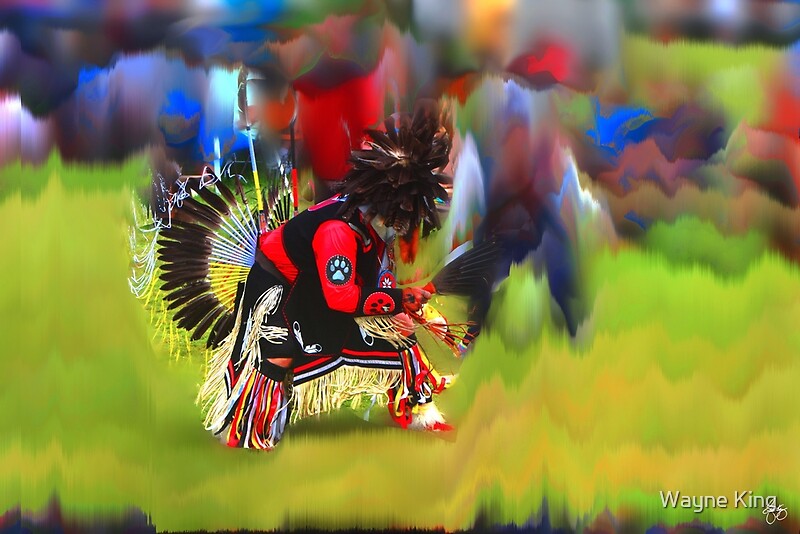
Color Image by Wayne D.King
Taken at the National Mall, Washington, DC at the Pow Wow celebrating the opening of the Smithsonian Museum of the American Indian.
It is likely that the White Mountains were first inhabited by humans about 12,000 years ago, after the last ice age. These first peoples had migrated from the west and were the forebears of those whom Columbus would mistakenly call Indians. The region was rich with wildlife, fish, and edible plants.
Formal “Tribes” began to form about 3000-4000 BC.
There were two overlapping groups of Native Americans in this region: the Penacooks and the Penobscots, with the Penacooks being dominant as the Penobscots were located largely in what would later become the State of Maine.
Both were tribal branches within the regional Abenaki nation.
In the early 1600s the Penacook confederation had 17 tribes, all of whom spoke the Algonquin language. Because there was no written form of this language, much of what we now know of their life is derived from the records of European colonists. The tribes resided along the Pemigewasset and Merrimack watershed and near Great Bay. The Pequawkets, Chocorua’s tribe, were originally part of the Penobscot tribal confederation, but became allied with the Penacooks after the Europeans began to settle the White Mountains.
Chocorua was a Sachem, or chief, who led his small band after most of the Pequawkets had moved north into Canada to avoid conflict with the white man.
Chocorua, a proud and courageous man, refused to go. He was unwilling to leave the land of his ancestors. He had raised his son Tuamba to believe that the land belonged to all of the great spirit’s creatures. He remained and made efforts to live in harmony with the new settlers, despite their differences.
He befriended settler Cornelius Campbell and his family. Setting in motion one of the great tragedies of Native American history.
Chocorua trusted the Campbells enough to put Tuamba in their care while he went north for a tribal council and pow-wow. According to the legend, while Chocorua was away, Tuamba ate some poison that was meant to kill marauding wolves and died.
Some time later, while Cornelius was away from the farm, Chocorua returned to find his son had died. Stricken with grief and anger. he killed Cornelius' wife and young son.
Returning to his mountains heartsick at the loss of his beloved Tuamba, Chocorua must have known that this story was not over.
When Cornelius discovered that his family had been slain, he knew that Chocorua was responsible and set off to avenge his loved ones. Cornelius pursued Chocorua to the top of the highest mountain peak in the area, a jagged pointed peak - the peak that now bears the name of Chocorua. Chocorua climbed atop the highest boulder on the summit and, knowing that death was at hand, raised his arms to the sky and is said to have shouted, "Evil spirits breathe death upon the cattle of the white man! Wind and fire destroy your dwellings! Panthers and wolves howl and grow fat on your bones. Chocorua goes now to the Great Spirit!" Chocorua then leapt off the mountain and fell to his death on the rocks below.
Two years later, the body of Cornelius was found dead, partially eaten by wolves.
It is said that one hundred years to the day of his death a devastating plague killed all the cattle from Albany to Conway, New Hampshire. The cause of this plague has been explained by scientists, of course, but those of us inclined to the romance of the mountains still believe that the curse of Chocorua was involved.
Pow
Wows were originally held in the spring to celebrate the new beginning of life.
It was a time for people to get together, sing, dance, renew old friendships
and make new ones.
Today
Pow Wows, or celebrations, are very much a part of the lives of many Native
American people. Pow Wows are a mixture of celebration, social gatherings and
friendly dance competitions, shared by the " Generations" of people.
But, as the sacred thread that runs through all life, there are sacred
traditions to be found in this coming together of people.
Pow Wows vary in size and are held throughout the country. The Mt Kearsarge Indian Museum Pow Wow
is probably the fastest growing Pow Wow in the state and an ideal way to start if you have never been to
one because there will be lots of other "first-timers". You need not be Native American to attend but in many cases exhibitors are
required to be of Native descent.
A number of small local Pow Wows pop up every year around the state but whether they will continue from one year to another is unpredictable.
Donated, by Charles and Elynor Taylor of Wilmot, in 1983 to the newly incorporated Historical Society the Potter Place Railroad Station is the venue for the Andover Historical Society Museum. The Museum contains an authentic "stationmaster's office," rooms for other exhibitions, and a gift shop.
In 1987 a Northern Railroad Caboose and Snow Plow were obtained and moved to the tracks near the station. Although in 1993 the Society parted with the snow plow because it was unable to restore it as it needed, the Caboose remains as part of the historic railroad exhibit of the Society.
The Society Museum is open every weekend from Memorial Day to Columbus Day, and the Society holds several meetings throughout the year with speakers on topics of interest to the townspeople, and occasionally Historic Walks to places of interest in the town.
For more information, you can contact: Andover Historical Society PO Box 167 Andover NH 03216