HOW MAPLE SYRUP IS MADE
Pure maple syrup is made by boiling down the slightly sweet sap of the sugar maple tree. In late February or early March, syrup producers (called sugarmakers) prepare for their annual harvest of the maple sap. The sugarmaker prepares his sugarbush (maple orchard) by clearing access roads in the snow, removing fallen branches, and setting up his buckets or sap tubing systems. Whether they use tubing or buckets, commercial sugarmakers must be sure that all their sap gathering, collecting, evaporating and bottling equipment is absolutely clean and in good condition before the beginning of the season. You could do it in your backyard without the careful preparation, but those who provide it for our tables must meet very strict codes created by the United States Department of Agriculture.
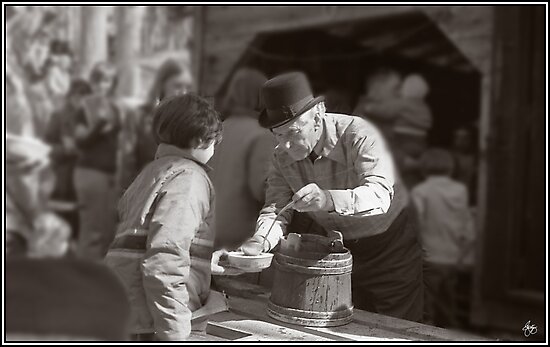 |
| Sugaring Off |
A sugarmaker must be completely in tune with his/her environment because there is no set time at which sugaring begins.. The sugarmaker must be aware of the clues of nature to tell him or her when the time is right: Days become warmer, the streams run with melting snow, icicles drip faster, the birds announce the not-too-distant arrival of spring. This is the time known as "sugar weather," . Nights fall below freezing but the days are mild. These conditions make the sap flow.
When the sugar farmer feels the time is "right" he/she will start to tap the trees. Tapping involves going from tree to tree in the sugarbush, drilling, upslanting holes into the wood which carries the sap. If buckets are used to collect the sap, a metal spout or "spile" is tapped snugly into the hole, and a bucket is hung from a hook on the spout. A cover is put on the bucket to keep out rain, snow, and debris. If a plastic tubing system is used to collect the sap, a plastic spout, which is connected to the pipeline system, is tapped into the hole in the tree.
The maple tree must be about 40 years old and in good condition before it can be tapped. The hole is usually placed about waist high on the tree. Larger trees may accomodate more than one tap hole if they are healthy. But a sugarmaker must be careful about this. These trees are the sugarmakers livelihood and they must be cared for and nurtured for the future. Trees that are in poor health or have been defoliated by insects are often tapped less, or not tapped at all. If proper taping procedures are followed, tapping will not endanger the health and vitality of the tree. A healthy sugar maple can provide sap every year for a hundred years or more.
The sugaring season will last approximately one month. On average it takes approximately 40 gallons of sap to produce 1 gallon of syrup but this varies widely from season to season and tree to tree.
When the trees have been tapped and all the equipment is ready, the sugarmaker is ready for the "first run," when the sap first starts to flow.
Just as garderning in New England is dependent upon climate zones, so too is sugaring. New England sugarhouses often start and stop boiling at different times due to local weather patterns and region. If you have missed the sugaring season in Connecticut and Massachusetts you may still be able to catch it in Northern Maine or Vermont and New Hampshire.
Mark Twain once said "if you don't like our New England weather . . . just wait a bit" summing up the changeable nature of New England's weather patterns. Sugarmakers are subject to these vagaries of the weather as well. Warm spells or cold snaps during the season may halt sap flow for a day or two, and it may start again when conditions are favorable. On days when the sap runs, the sugarmaker may live a frenzied existance with little sleep but a cold spell or warm spell will provide just enough down time to prepare for the next run.

Albert Camus Quote
"In the depth of winter
I finally learned
that there was in me
an invincible summer."
~ Albert Camus
Maple syrup is traditionally made in a building called a "sugarhouse" . Sugarhouses vary widely still from rustic wood buildings out in the woods with poor access and no electricity, full of old memories of seasons passed to modern processing plants, brightly lit and streamlined. Regardless of the age, every sugarhouse will have vent cupola at the top that is opened to allow the steam of the boiling syrup to vent. An evaporator is used to boil down the sap into syrup. Evaporators are made up of one or more flat pans which sit on a firebox. Wood or oil, and sometimes gas or coal is burned at the front end, and the flames are drawn along the underside of the pan, heating and boiling the sap as they travel towards the rear.
The basic design of maple syrup evaporators has changed little over the years, although modern sugarmakers have created new methods to replace the necessity of ladeling boiling sap from one pan to another. The size of the evaporator really depends upon the scale of the operation. If you want to try boiling sap yourself you could do it over a fire outdoors or in your kitchen. Be aware however that the amount of steam produced boiling sap down inside may have a detrimental effect on wallpaper or other finsh work so use caution and judgement about boiling inside. . . there's a reason for those cupola vents!


